
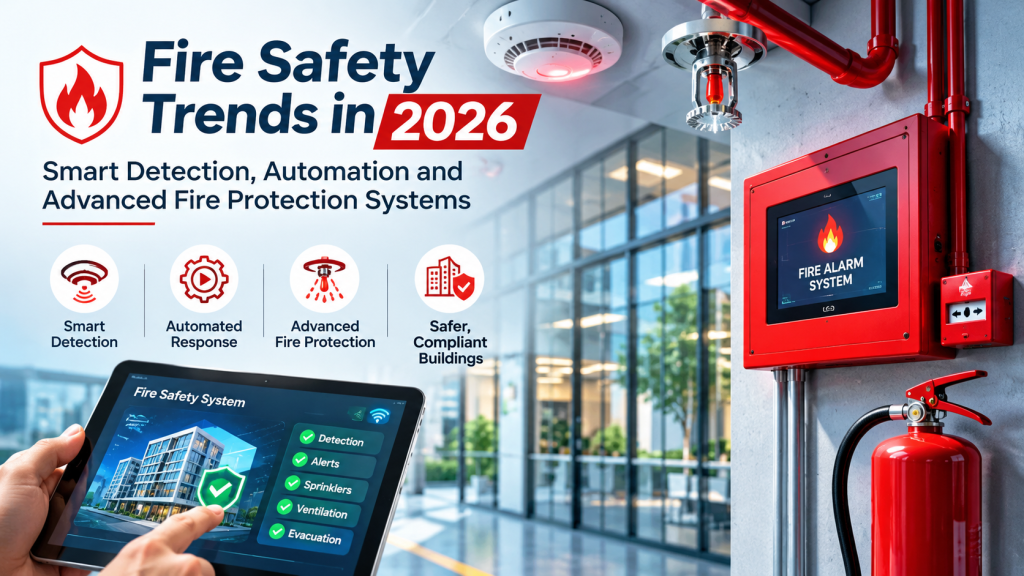
Fire Safety Trends in 2026: Smart Detection, Automation and Advanced Fire Protection Systems
Fire safety is becoming an increasingly important part of modern building design and infrastructure management. As cities expand, commercial buildings become more complex and industrial facilities adopt advanced technologies, protecting people, property and business operations requires more than traditional firefighting equipment.
In 2026, the fire protection industry is seeing increased attention towards smart fire detection, Internet of Things (IoT) monitoring, automated fire protection, intelligent alarm systems and digitally connected safety infrastructure.
These technologies are changing how buildings detect fire-related risks, communicate emergencies and monitor the condition of firefighting equipment.
For property developers, facility managers, industrial operators and housing societies, understanding these developments is essential when planning new fire safety installations or upgrading existing systems.
India is also seeing greater emphasis on continuous monitoring of fire protection infrastructure. Maharashtra’s Automated Continuous Monitoring System (ACMS) framework, for example, introduces IoT-based monitoring requirements for specified building fire protection systems.
If you are looking for advanced fire protection systems in Pune, understanding the latest technologies can help you select suitable solutions for your building.
In this guide, we explore the major fire safety trends in 2026, how automation and smart detection work, the benefits of modern fire protection systems and what businesses should consider when choosing a professional fire safety provider.
1. Smart Fire Detection Systems Are Transforming Building Safety
One of the most important fire safety trends in 2026 is the growing adoption of intelligent fire detection technology.
Traditional fire alarm systems use detectors to identify smoke, heat or other fire-related conditions and activate alarms. Modern intelligent systems can provide additional features such as individual device identification, system diagnostics, digital event records and remote monitoring.
What are smart fire detection systems?
Smart fire detection systems combine compatible detectors, fire alarm control panels and communication technologies to identify potential fire conditions and communicate information to building occupants or authorised personnel.
Depending on the installation, these systems may include:
- Smart smoke detectors.
- Heat and thermal detectors.
- Carbon monoxide detectors.
- Addressable fire alarm panels.
- Manual call points.
- Audible and visual alarm devices.
- Remote monitoring interfaces.
- Communication gateways.
When a detector identifies a specified condition, it communicates with the control panel, which initiates the programmed alarm response.
Some connected installations can also transmit alarm and fault information to a remote monitoring platform.
Why are smart detection systems important?
Smart detection can help building managers identify the affected area, understand system events and respond to equipment faults more efficiently.
For example, an addressable fire alarm system can identify the individual detector that has activated rather than indicating only a general detection zone.
This can help authorised personnel locate the affected area more quickly.
Smart detection systems are increasingly relevant in:
- High-rise residential buildings.
- Shopping malls.
- Corporate offices.
- Hospitals.
- Educational institutions.
- Factories and industrial facilities.
- Warehouses and logistics centres.
The actual system design should always depend on building occupancy, fire risk, layout and applicable fire safety requirements.
2. IoT-Based Fire Safety Monitoring Is Becoming a Major Trend
The Internet of Things connects physical devices through communication networks so that information can be collected, shared and monitored.
In fire protection, IoT technology can connect selected fire alarm and firefighting equipment to a digital monitoring platform.
Instead of relying only on periodic physical inspections, authorised personnel can receive information about selected equipment conditions through a connected system.
How does IoT fire safety monitoring work?
An IoT-based monitoring arrangement generally includes:
- Connected sensors: Collect information about equipment status, pressure, temperature or other specified conditions.
- Communication gateway: Transfers the collected information through an approved communication network.
- Cloud monitoring platform: Receives and processes the data.
- Dashboard or mobile application: Displays equipment status and relevant notifications.
- Maintenance response: Allows authorised teams to investigate faults and arrange corrective action.
What equipment can be monitored?
Depending on the applicable framework and installation, connected monitoring can cover:
- Main fire hydrant pumps.
- Standby diesel or electrical pumps.
- Jockey pumps.
- Fire sprinkler pumps.
- Hydrant and sprinkler riser pressure.
- Underground fire water tank levels.
- Overhead fire water tank levels.
- Fire detection panel status.
- Repeater panel operating conditions.
This information can help building operators identify certain equipment problems before an emergency occurs.
Maharashtra’s ACMS framework in 2026
Maharashtra introduced Automated Continuous Monitoring System provisions through its Fire Prevention and Life Safety Measures Amendment Rules, 2025.
The framework describes IoT-based monitoring of specified active and passive fire prevention and life safety measures. It includes provisions for collecting system status through an IoT gateway and sending information to a cloud server for notifications to owners or occupiers and the appointed licensed agency.
The rules also describe a phased approach to communicating critical alarms.
This is an important development for building owners and facility managers in Maharashtra because it places greater emphasis on monitoring the operating condition of fire protection infrastructure.
However, ACMS applicability depends on the relevant statutory provisions and specified building categories. Property owners should confirm their obligations with Maharashtra Fire and Emergency Services or a qualified licensed agency.
3. Automation Is Improving Fire Detection and Emergency Response
Automation is another important development in modern fire safety.
A properly designed fire protection system can automatically initiate selected actions when a fire-related condition is detected.
This reduces dependence on manual activation for every part of the emergency response.
Automatic fire alarm activation
When a smoke or heat detector identifies a specified condition, the fire alarm control panel can activate connected audible and visual warning devices.
This helps alert occupants and building management teams.
Automated sprinkler activation
Automatic sprinkler systems use heat-responsive sprinkler heads. When the temperature around an individual sprinkler head reaches its operating threshold, the element activates and releases water in the affected area.
Sprinklers are designed to control or suppress fires depending on the system design and conditions. They should not be confused with smoke detectors or general alarm devices.
Automatic fire suppression systems
Some high-risk environments require specialised suppression systems.
Depending on the application, these may include:
- Clean-agent fire suppression systems.
- CO₂ fire suppression systems.
- Foam-based suppression systems.
- Water mist systems.
- Specialised kitchen suppression systems.
The correct system depends on the fire hazard, protected equipment, occupancy and applicable safety requirements.
Integration with building management systems
Fire alarm systems can be integrated with selected building systems to support programmed emergency responses.
These may include:
- Smoke extraction systems.
- Staircase pressurisation fans.
- Air handling systems.
- Emergency public address systems.
- Fire doors.
- Selected access-control interfaces.
- Emergency lighting arrangements.
Such integration must be professionally designed and tested. Fire alarm priorities and emergency functions must not be compromised by normal building automation.
4. Advanced Fire Detection Technologies to Watch in 2026
Modern buildings have different fire hazards, which is why one type of detector may not be suitable for every area.
Here are some important technologies used in advanced fire detection planning.
A. Intelligent smoke detectors
Smoke detectors identify smoke particles and communicate detection signals to a compatible fire alarm system.
Modern models may support improved device identification, diagnostics and system integration.
They are commonly considered for offices, residential buildings, commercial premises and other occupied spaces.
B. Heat and thermal detectors
Heat detectors respond to specified temperature conditions or temperature increases.
They may be suitable for areas where environmental conditions such as dust, steam or cooking activity can affect smoke detector performance.
The choice between fixed-temperature and rate-of-rise detection depends on the application.
C. Carbon monoxide detectors
Carbon monoxide is a dangerous gas that cannot be detected through smell or sight.
CO detectors identify specified gas concentrations and provide warnings.
They are relevant in areas with potential carbon monoxide sources, such as generators, boilers and fuel-burning equipment.
D. Flame detectors
Flame detectors identify specific radiation patterns associated with flames.
They are used in selected industrial and high-risk environments where rapid flame detection is required.
Detector selection depends on the expected fire type, environmental conditions and equipment specifications.
E. Aspirating smoke detection
Aspirating smoke detection systems continuously draw air samples through a network of pipes and analyse them for smoke particles.
These systems can be useful in environments requiring very early smoke detection, such as:
- Data centres.
- Server rooms.
- Telecommunications facilities.
- Clean rooms.
- Certain industrial installations.
F. Video-based fire detection
Video-based fire detection uses specialised camera systems and image-processing technology to identify visual signs of smoke or flames.
It may be considered in large open spaces, industrial environments and selected facilities where conventional detector placement is challenging.
The effectiveness depends on camera positioning, lighting, environmental conditions and system design.
5. Advanced Fire Suppression Systems Are Protecting Critical Infrastructure
Fire detection is only one part of a complete fire safety strategy.
When a fire occurs, an appropriate suppression system may be required to control or extinguish it.
The system should be selected according to the building’s fire hazards, occupancy and protected assets.
Fire sprinkler systems
Sprinkler systems use a network of pipes and heat-responsive sprinkler heads to release water in the affected area.
They are widely used in commercial, industrial and residential building applications where required by the fire safety design.
Benefits include:
- Automatic activation under specified conditions.
- Localised water discharge from activated sprinkler heads.
- Support for fire control.
- Integration with fire pump and alarm arrangements.
Fire hydrant systems
Fire hydrant systems provide water supply points for firefighting operations.
They generally include hydrant pumps, piping, valves, hydrant outlets and associated equipment.
A properly designed hydrant system helps trained firefighting personnel access water during emergencies.
Clean-agent fire suppression systems
Clean-agent systems are used in selected environments where water discharge may damage sensitive equipment.
Potential applications include server rooms, data centres and electrical equipment areas.
The selected agent, design concentration, enclosure integrity and personnel safety requirements must be evaluated carefully.
CO₂ fire suppression systems
Carbon dioxide systems are used in selected industrial and equipment protection applications.
CO₂ can create dangerous atmospheres for people, so these systems require appropriate safety design, warnings, evacuation arrangements and discharge controls.
Foam-based fire suppression systems
Foam systems are designed for selected flammable-liquid fire hazards.
They are commonly considered in appropriate industrial, fuel storage and process environments.
The foam type and system design must match the specific hazard and applicable environmental requirements.
6. Fire Safety Is Becoming More Data-Driven
Another important trend is the growing use of digital records and monitoring data to support fire safety management.
A modern building may contain hundreds of detectors, alarm devices, pumps, valves and other fire protection components.
Tracking the condition of all these devices manually can be challenging, particularly in large facilities.
Digital monitoring can help organise this information.
Digital equipment status records
Connected platforms may record information such as:
- Equipment operating status.
- Alarm activation history.
- Fault notifications.
- Communication failures.
- Pump run status.
- Water tank level readings.
- Maintenance-related events.
Predictive maintenance opportunities
When monitoring data is available over time, facility teams may identify recurring problems or unusual equipment behaviour.
For example, repeated pump faults or pressure variations may indicate the need for investigation.
However, predictive analytics should support, not replace, the prescribed inspection, testing and maintenance programme.
Centralised fire safety dashboards
Large facilities may use dashboards to view the status of multiple connected systems.
This can help facility managers organise maintenance activities, assign responsibilities and review important system events.
7. Fire Safety Regulations and Compliance Are Receiving Greater Attention
Technology is important, but fire safety systems must also meet applicable regulatory and technical requirements.
In India, building fire safety is guided by the relevant state fire service laws, local building regulations, applicable Indian Standards and the building’s approved fire safety design.
National Building Code and Indian Standards
The National Building Code provides guidance on building construction, fire prevention and life safety.
Relevant fire detection and alarm system requirements also involve Indian Standards, including IS 2189 for selection, installation and maintenance of automatic fire detection and alarm systems.
Property owners should check the current applicable editions and local adoption requirements rather than relying on outdated specifications.
Maharashtra fire safety requirements
Maharashtra’s Fire Prevention and Life Safety Measures Act and associated rules establish requirements for specified buildings and fire protection installations.
The 2025 amendment rules introduced ACMS provisions for relevant building categories.
Building owners should review their building’s applicable approvals, fire safety measures, inspection requirements and certification obligations with the competent authority or a licensed agency.
Why professional compliance assessment matters
A fire protection installation should be designed according to the actual building and its intended use.
A compliance assessment should consider:
- Building occupancy.
- Building height and layout.
- Fire load and potential hazards.
- Required detection and alarm coverage.
- Fire water storage and pumping arrangements.
- Hydrant and sprinkler requirements.
- Emergency exits and evacuation arrangements.
- Maintenance and inspection records.
A generic equipment list is not a substitute for a building-specific fire safety design.
8. Fire Safety Trends Across Different Industries
Different industries face different fire risks. Modern fire protection strategies should reflect those differences.
Commercial offices and IT buildings
Commercial buildings may contain electrical equipment, server rooms, meeting areas and large numbers of occupants.
Smart detection, addressable alarm systems and selected suppression technologies can help support building safety.
Hospitals and healthcare facilities
Healthcare buildings require special attention because patients may have limited mobility and may depend on staff for evacuation.
The 2026 National Guidelines on Fire and Life Safety in Healthcare Facilities emphasise suitable fire detection and alarm systems, emergency communication, fire compartmentation, emergency lighting and safe evacuation planning.
Manufacturing and industrial facilities
Industrial premises may contain machinery, combustible materials, chemicals and high-risk production processes.
Fire safety planning may involve specialised detectors, hydrant systems, sprinklers, foam systems and other hazard-specific protection.
Warehouses and logistics centres
Warehouses can have high fire loads and complex storage arrangements.
Detection and suppression design should consider storage height, material types, airflow and the building’s layout.
Residential apartments and housing societies
Residential complexes need suitable fire protection arrangements for common areas, basements, electrical rooms, service spaces and other relevant locations.
Regular maintenance and awareness among residents and facility teams are equally important.
Data centres and server rooms
Data centres contain critical electrical and electronic infrastructure.
Early smoke detection, suitable suppression technology, environmental monitoring and carefully planned emergency procedures are important considerations.
9. How to Choose the Right Fire Protection System for Your Building
Selecting a fire safety system should begin with a detailed understanding of the building’s risks.
Consider the following factors before selecting a fire safety provider.
1. Understand your building’s fire risks
Identify the building’s occupancy, combustible materials, electrical installations, equipment and potential ignition sources.
2. Select suitable detection technologies
Different areas may require smoke, heat, flame or other specialised detectors.
3. Plan fire suppression requirements
Determine whether the building requires sprinklers, hydrants, clean-agent systems, foam suppression or another suitable arrangement.
4. Check system integration
Ensure that alarm panels, detectors, pumps, notification devices and connected monitoring equipment are compatible.
5. Verify product quality and documentation
Ask for product specifications, relevant certifications, technical documents and installation details.
6. Review installation and commissioning
The contractor should provide a clear installation scope, testing process and commissioning documentation.
7. Plan regular maintenance
Confirm inspection intervals, testing responsibilities, fault response and technical support.
8. Check contractor qualifications
For projects in Maharashtra, verify the relevant licensing, approval and technical qualifications required for the proposed work.
10. Why Regular Fire Safety Maintenance Is Essential
Installing a fire protection system is only the beginning of building safety management.
Detectors can become dirty or damaged, pumps can develop faults, batteries can deteriorate and alarm communication systems can experience failures.
Regular maintenance helps ensure that equipment remains in good working condition.
A planned maintenance programme should cover:
- Smoke and heat detector testing.
- Fire alarm control panel inspection.
- Manual call point testing.
- Audible and visual alarm testing.
- Fire pump operation checks.
- Hydrant system inspection.
- Sprinkler system inspection.
- Fire water tank level checks.
- Emergency power supply checks.
- Communication and monitoring system checks.
- Documentation of faults and corrective actions.
Maintenance should follow the applicable standards, manufacturer’s instructions and relevant fire safety requirements.
11. Why Choose Sterling Fire System for Advanced Fire Protection in Pune?
Selecting a suitable fire safety provider is an important decision for building owners, developers and facility managers.
Sterling Fire System provides fire detection and fire protection solutions for residential, commercial and industrial properties in Pune.
The company offers services and equipment covering different areas of fire safety, including fire detection systems, smart smoke detectors, heat and thermal detectors, integrated alarm systems, fire hydrant systems, sprinkler systems and fire safety equipment.
Fire detection and alarm solutions
Sterling Fire System offers fire detection solutions designed to identify potential fire conditions and alert building occupants.
Suitable detection and alarm arrangements can help support early warning and organised emergency response.
Fire protection systems
The company provides fire protection solutions for buildings and facilities requiring firefighting infrastructure.
These include hydrant and sprinkler-related systems, depending on project requirements.
Solutions for different building types
Fire safety requirements differ between commercial buildings, industrial facilities, hospitals, educational institutions and residential projects.
Sterling works across different property categories to address fire detection and protection requirements.
Installation and maintenance support
Professional installation, testing and regular maintenance are important for system reliability.
Building owners should ensure that fire protection equipment is properly commissioned and maintained according to the applicable requirements.
Discuss your fire safety requirements with Sterling
Whether you are developing a new building, upgrading an existing fire alarm installation or reviewing fire protection requirements for an industrial facility, professional guidance can help you identify an appropriate solution.
Visit Sterling Fire System to explore fire detection and fire protection services in Pune.
Website: https://sterlingfiresystem.com/
Phone: +91 8698540111
Email: info@sterlingfiresystem.com
Address: Shop No. 32, Silver Stone Building, Ground Floor, Handewadi Chowk, Handewadi, Pune – 412308.
12. Frequently Asked Questions About Fire Safety Trends in 2026
1. What are the latest fire safety trends in 2026?
Important developments include smart fire detection, IoT-based monitoring, addressable alarm systems, automated fire suppression, digital equipment monitoring and improved integration with building management systems.
2. What is a smart fire detection system?
A smart fire detection system uses compatible detectors and control panels to identify fire-related conditions. Depending on its configuration, it can also provide device identification, fault reporting and remote monitoring.
3. How does IoT improve building fire safety?
IoT can connect selected fire protection equipment to a digital platform. It can help authorised personnel monitor equipment status, receive alerts and identify certain system faults remotely.
4. What is an Automated Continuous Monitoring System?
ACMS is an IoT-based arrangement that monitors selected fire protection and life safety equipment. It can collect information about pumps, water tanks, sprinkler systems and detection panels and communicate relevant status information to authorised users.
5. Are IoT-based fire safety systems mandatory in Maharashtra?
Maharashtra’s 2025 amendment rules introduce ACMS provisions for specified buildings under the relevant statutory framework. Applicability depends on the building category and applicable requirements. Owners should confirm their obligations with the competent fire authority or a licensed agency.
6. What is the difference between fire detection and fire suppression?
Fire detection systems identify fire-related conditions and activate warnings. Fire suppression systems are designed to control or extinguish a fire using suitable agents such as water, foam, clean agents or other approved technologies.
7. Which fire detection system is best for commercial buildings?
The right system depends on the building’s size, occupancy, layout and fire risk. Addressable fire alarm systems with suitable smoke and heat detectors are commonly considered for commercial buildings, subject to professional design.
8. What are advanced fire protection systems?
Advanced fire protection systems can include intelligent fire alarms, addressable detectors, automatic sprinklers, hydrants, specialised suppression systems, emergency communication and connected monitoring technologies.
9. How often should fire safety equipment be maintained?
Maintenance intervals depend on applicable regulations, standards, equipment type and manufacturer instructions. Building owners should maintain a documented inspection and testing schedule.
10. Where can I find fire protection system providers in Pune?
Sterling Fire System provides fire detection and fire protection solutions in Pune. Contact the company to discuss your building’s installation, equipment and maintenance requirements.
Conclusion: Building a Safer Future with Advanced Fire Protection Systems
Fire safety in 2026 is moving towards a more connected, automated and data-driven approach.
Smart fire detection, IoT monitoring, automatic suppression and digital equipment status monitoring can help building owners and facility managers improve visibility into their fire protection infrastructure.
However, modern technology must work alongside proper system design, suitable equipment, professional installation, regulatory compliance, regular maintenance and effective emergency procedures.
For commercial buildings, industrial facilities, hospitals, warehouses and residential complexes, investing in an appropriate fire protection strategy is an important step towards protecting people, property and business operations.
If you are planning to upgrade or install fire safety systems in Pune, consult a professional provider to evaluate your requirements.
Choose a smarter approach to building safety with Sterling Fire System. Explore professional fire detection and fire protection solutions for your property today.
